


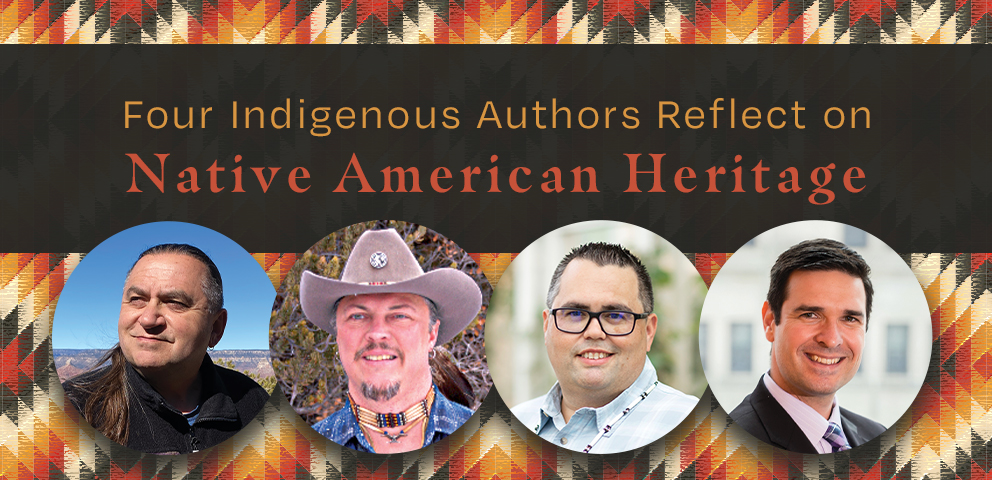
Four Indigenous Authors Reflect on Native American Heritage
In this article, four authors share wisdom from their stories, cultures, and faith journeys. T. Christopher Hoklotubbe, Terry Wildman, Randy Woodley, and H. Daniel Zacharias offer reflections on what they treasure most about their heritage, what they wish others understood, and why Indigenous wisdom is vital for the future of the church and the world.
What do you most treasure about your culture and background?

Terry Wildman, project manager for the First Nations Version (FNV): Even though I often mourn growing up outside of my Native ancestry and culture, I deeply value what I have been able to learn and reclaim over the last twenty-five years. The guidance of mentors who are deeply connected to their tribal roots has shaped my path. Two naming ceremonies and several sweat-lodge ceremonies centered around Creator Sets Free (Jesus) have been especially meaningful.
I deeply value my relationships with dear Native friends, which—along with the five years I spent living on the Hopi reservation—have given me spiritual insights and a relational understanding of Creator that the Western culture I was raised in simply could not offer.
I’ve come to value how Native culture brings faith into a holistic relationship—with the land, the people, and the stories that carry wisdom across generations. That way of living and believing has deeply shaped my journey and my work on the First Nations Version, as I try each day to walk Creator’s good road, led by his Son and Spirit.
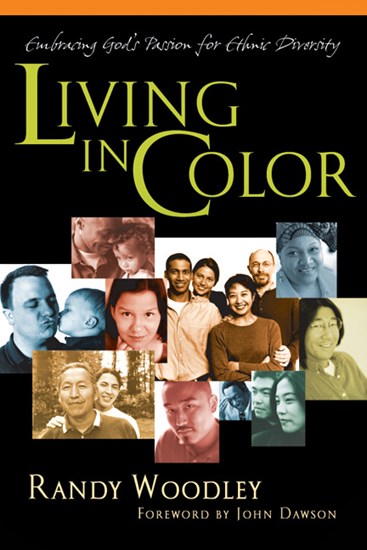
Randy Woodley, author of Living in Color: The foundational worldview, which is an understanding that we’re related to all of creation—that’s the treasure I come back to daily. On our farm, this isn’t abstract theology; it’s how we live. When we save seeds or tend the soil or watch eagles circle overhead, we’re engaging with relatives, not resources. My mother taught me this before I had words for it, and my wife, Edith, and I now live it out on every acre of Eloheh Indigenous Center for Earth Justice and Eloheh Farm & Seeds. This worldview holds the antidote to the extractive, exploitative relationship with creation that’s killing the planet. It’s sophisticated wisdom that Euro-Western cultures desperately need. What I treasure most is that this way of being is resilient—it survived genocide, forced assimilation, and centuries of attempts to erase it. It’s still here, and it still works. And we all need an Indigenous worldview to survive well into the future.

H. Daniel Zacharias, coauthor with T. Christopher Hoklotubbe of Reading the Bible on Turtle Island: The worldviews and lifeways of my cultural heritage provide me with something essential to every human being—a place of belonging and rootedness, and cultural tools to process life and, in my case, to live out Christian faith in a way that honors who I am.
T. Christopher Hoklotubbe: I appreciate the Chata (Choctaw) hymns, many of which were sung along the trail of tears. For the Choctaw people, who pride themselves on embodying the values of faith, family and culture, all three come together in the traditional singing of these hymns.
What is one thing in particular that you wish others knew or better understood about Native American history and culture?
Terry Wildman: I wish people understood that Native identity is not a relic of the past, but a living journey. Tribal nations are still here—often overlooked—and many of us are working to reclaim as much as we can of what was lost. Our ceremonies, our languages (even those being recovered), and our spiritual perspectives are gifts from our Creator and treasured gifts to society if they have ears to hear.
The truth—both historically and today—is that many Native people have been forced to live in two worlds in order to survive. Recognizing that tension can lead to deeper understanding and respect for the resilience and wisdom within Native communities.
Randy Woodley: We're still here, and we’re not a historical footnote. Too many people relate to Indigenous peoples in the past tense, as if we died out with the buffalo or got absorbed into some romantic sunset. While it’s true that I actually don’t have that much Native American blood, I cherish the worldview my ancestor’s held and try to make them proud. But, the violence didn't end in the
1800s—it continues in environmental racism, in the epidemic of missing and murdered Indigenous women, in the ongoing theft of Native land and water rights. At the same time, we’re not just victims of tragedy. We’re scientists developing climate-resilient seeds, we’re theologians reimagining Christianity outside colonial frameworks, we’re artists and activists and farmers. We’re your neighbors—and yes, some even have wifi on the rez now. (That’s a joke). The Indigenous future isn’t about returning to a romanticized past; it’s about applying ancient wisdom to contemporary crises in ways that could save us all. That’s what people miss: Indigenous knowledge isn’t museum material, it’s survival technology for a planet in crisis. Turns out our ancestors were the original environmentalists, and they didn’t need a Patagonia jacket to figure it out. Oh, and also we have a really good sense of humor…some of us anyway.
Danny Zacharias: In terms of history, people just need to know the history of Indigenous peoples in their country. History on this continent did not begin when Columbus was found lost on our shores, and it is not a “woke” agenda to teach and remember the full history of a place, the good and the bad.
For instance, one part of understanding the history of these lands is knowing that modern state divisions are arbitrary. I currently reside in Mi’kma’ki, the ancestral and unceded territory of the Mi’kmaq peoples. Mi’kma’ki encompassed all of Nova Scotia and Prince Edward Island, part of Newfoundland and Labrador, part of New Brunswick, part of Quebec, and part of Maine. Canadian provincial borders, nation-state borders, and US state borders are relatively recent in the history of these lands. As we discuss Native American Heritage Month, we need to learn that these modern borders broke up territories of the First Peoples, and we need to also know that Canada celebrates Indigenous History Month in June, with my current home province celebrating Mi’kmaq history month in October.
In terms of culture, on the whole Indigenous cultures are much more holistic and balanced than modern Western culture. Indigenous people can be your teachers and bring healing to our very fractured and disintegrated lives.
Chris Hoklotubbe: I wish others knew that they were invited into the dance, so to speak. Pow wows are generally open to all people and there are many inter-tribal dances where non-Indigenous people are invited to join. While there are many inspiring and challenging stories to learn about Indigenous culture and history on Turtle Island, I think the most transformative learning will only come after authentic relationships and friendships have been made.
In what new or unique ways would you like to see Native American Heritage Month observed?
Terry Wildman: I hope this month can become a time of shared storytelling in both Native and Christian communities. I’d love to see churches invite Native elders, storytellers, and translators—not only to share cultural heritage but also to talk about how they live their faith today. Including traditional voices alongside Christian ones helps us recognize the common ground in our stories, worldviews, and spiritual perspectives.
I would also like to see Christian leaders become advocates for Native voices—offering their platforms and choosing to listen, especially to how the message of Creator Sets Free (Jesus) was distorted through the church’s collaboration with government policies and boarding schools. I believe this kind of listening could foster healing, rebuild trust, and open new pathways toward restored relationships.
Randy Woodley: I’d like to see Native American Heritage Month move beyond the tired images of feathers and drums—though those are beautiful in their proper context—and into something that actually costs settlers something. What if churches and organizations used November to examine their own land relationships? Who lived on the land you occupy before you got there? What treaties were broken to make your presence possible? Better yet, what if Heritage Month became a catalyst for returning land to Indigenous communities or establishing conservation easements in partnership with local tribes? Observation without action is just performance. Let’s make it about repair, restoration, and right relationship. And maybe invite actual Native people to lead these conversations, not just attend a commemorative service where we’re trotted out like historical artifacts.
Danny Zacharias: That’s a big question to ask an Indigenous person, with responses that can happen at many levels. At the most basic level, Christians just need to care – care about the lands they live in, care about its history, and recognize the people that God originally gave the lands to. These are storied places, and settlers have very rarely chosen to place themselves into these stories and live well by them.
I would invite people to learn about the land they are on. Learn about the Indigenous people and stewards who traditionally called it home and territory, the treaties that were made (or broken) that allowed settlers to make new homes, and the ecosystems and watersheds that sustain it. With that knowledge, I’d invite people to re-engage the land around them with a prayer of gratitude and for eyes to see how you can leave it a little better than they found it as a good neighbor.
Chris Hoklotubbe: I would invite people to learn about the land they are on. Learn about the Indigenous people and stewards who traditionally called it home and territory, the treaties that were made (or broken) that allowed settlers to make new homes, and the ecosystems and watersheds that sustain it. With that knowledge, I’d invite people to reengage the land around them with a prayer of gratitude and for eyes to see how you can leave it a little better than they found it as a good neighbor.
If you could offer one piece of encouragement to Indigenous people right now, what would it be?
Terry Wildman: As someone who continues to walk the path of reclaiming my Native ancestry, I want to encourage you to hold onto and preserve whatever you have of your Indigenous identity. That identity is a sacred gift from our Creator and reflects his beauty and purpose in ways that are uniquely yours.
The world needs your voice, your prayers, your leadership, and your cultural wisdom. Stand firm in who you are—you carry something incredibly sacred that the wider culture has failed to recognize but deeply needs.
Randy Woodley: Your own people have survived worse than this, and the wisdom that carried them through is still alive in you. Whether you grew up on the rez or in the city, whether you speak your language or don’t, whether you know your clan or you’re still finding your way home—you belong to a story of resilience that spans millennia. The dominant culture will try to convince you that Indigenous ways are backward or irrelevant, but they’re lying to themselves as much as to you. The world is waking up to what our ancestors always knew about living in balance with creation. Your voice matters. Your presence matters. The way forward isn’t about perfectly reconstructing the past; it’s about carrying forward the essence of who we’ve always been and letting it speak to this moment. Don’t let anyone convince you that being Indigenous is about nostalgia. It’s about the future. And remember—we’ve been predicting the apocalypse for five hundred years; we’re the experts at surviving it.
Danny Zacharias: Continue to live as who you are and who Creator made you to be. Some of us did not have our culture or heritage passed on and have done the work of reclamation, while others have been steeped in their culture since birth. Continue to be proud and to be fierce. We belong to Creator, and we belong to these lands—it is who we are.
Chris Hoklotubbe: The path to healing and reconciling is through restoring relationships: with Creator, the land, and among ourselves. I encourage you to pray for the Holy Spirit to guide your consideration in how you might walk alongside Indigenous people as a good ally and friend in our work to restore land, protect water, build healthy communities, and revitalize traditional lifeways and languages.
About the Authors
T. Christopher Hoklotubbe

T. Christopher Hoklotubbe (ThD, Harvard) is a proud member of the Choctaw Nation of Oklahoma. He is the director of graduate studies of NAIITS: An Indigenous Learning Community, the first accredited Indigenous designed, developed, delivered, and governed theological institute. He is also assistant professor of classics at Cornell College (Mount Vernon, Iowa). He is the author of Civilized Piety: The Rhetoric of Pietas in the Pastoral Epistles and the Roman Empire, which was awarded the Manfred Lautenschläger Award for Theological Promise. He and his wife, Stephanie, have two daughters and live near Cedar Rapids, Iowa.
Randy Woodley
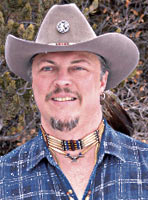
Randy Woodley (PhD, Asbury Seminary) is Distinguished Professor of Faith and Culture and the director of intercultural and indigenous studies at George Fox Evangelical Seminary. Woodley is a Keetoowah Cherokee Indian who has been in ministry among First Nations people since 1984. He is a teacher, poet, activist, former pastor, missiologist and historian. He and his wife, Edith (Eastern Shoshone/Choctaw), are cofounders of Eagle's Wings Ministry and are considered early innovators in the Native American Contextual Movement. He is a founding board member of NAIITS, the North American Institute for Indigenous Theological Studies, and he administers the Fox/ NAIITS cooperative Master of Arts Intercultural Studies degree. Woodley is active in the ongoing discussions concerning new church movements, racial and ethnic diversity, peace, social justice, interreligious dialogue and mission. He regularly blogs in these areas and is the author of Shalom and the Community of Creation: An Indigenous Vision and Living in Color: Embracing God?s Passion for Ethnic Diversity.
Terry M. Wildman
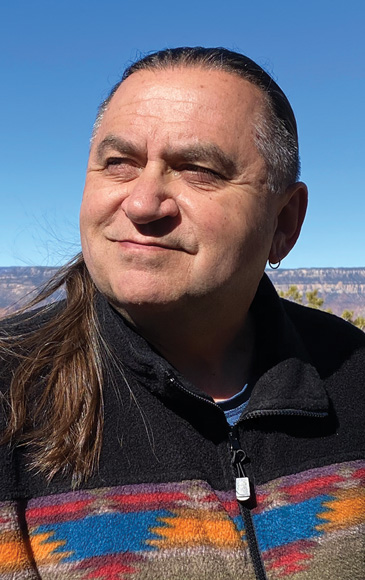
Terry M. Wildman (Ojibwe and Yaqui) is the lead translator, general editor, and project manager of the First Nations Version. He serves as the director of spiritual growth and leadership development for Native InterVarsity. He is also thefounder of Rain Ministries and has previously served as a pastor and worship leader. He and his wife, Darlene, live in Arizona.
H. Daniel Zacharias

H. Daniel Zacharias (PhD, Highland Theological College/Aberdeen) is a Cree-Anishinaabe/Métis and Austrian man originally from Winnipeg, Manitoba (Treaty One territory), with ancestors also residing in Treaty Two, Treaty Three, and Treaty Five territories. He lives in Mi’kma’ki (Nova Scotia) with his wife, Maria, and four children in Wolfville, NS. He is associate dean and professor of New Testament studies at Acadia Divinity College, where he has worked since 2007. He also serves as an adjunct faculty for NAIITS: An Indigenous Learning Community.


