
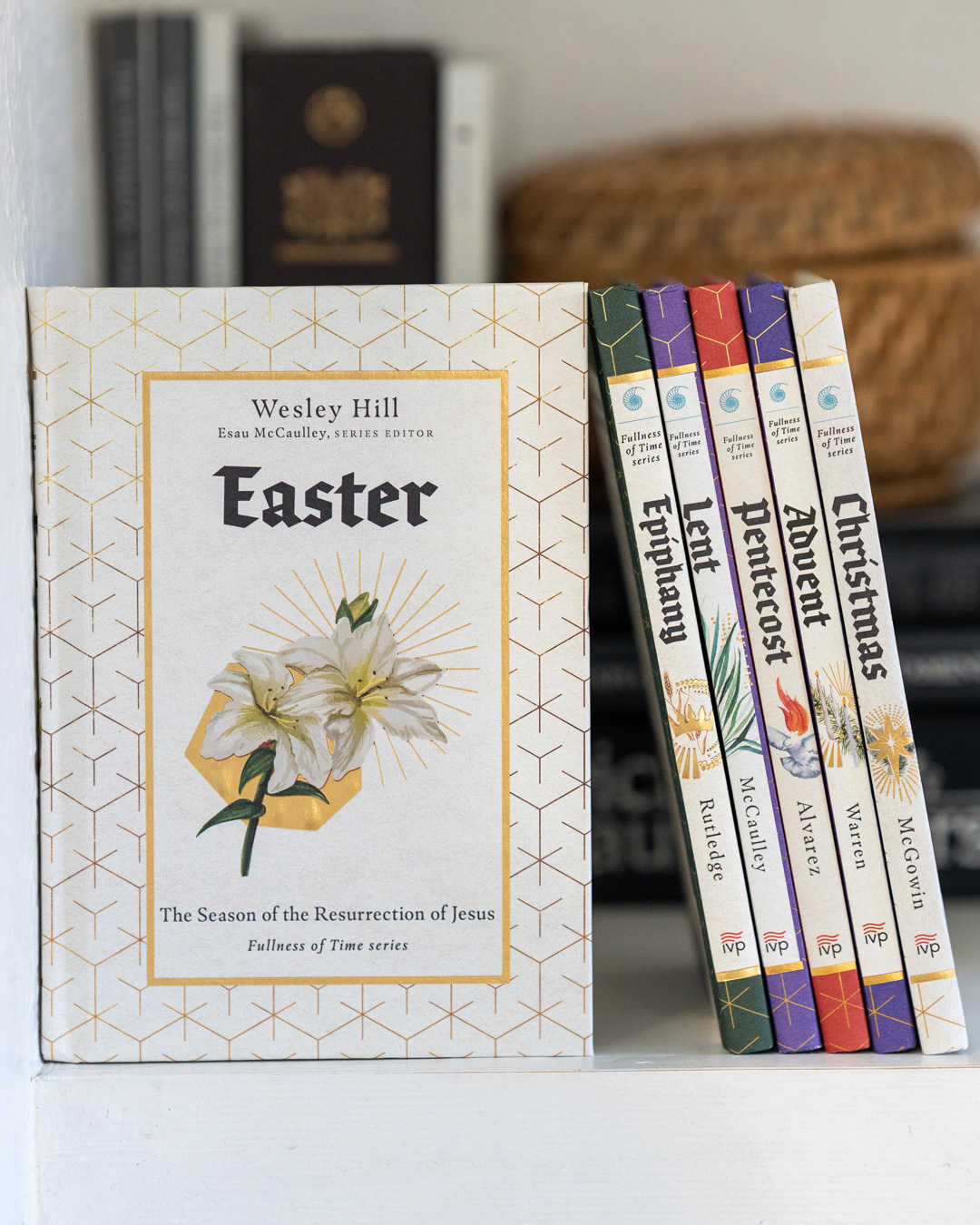
‘Easter: The Season of the Resurrection of Jesus’ by Wesley Hill
New Testament scholar and Anglican bishop N. T. Wright has said that it baffles him why many of us should observe the forty days of Lent with strictness and rigidity but then skimp on Easter joy. We are invited to observe all fifty days of Easter—which Athanasius and other early Christians understood as a “week of weeks,” seven full weeks of sevens, one great magna dominica, one long “Great Sunday”—by pulling out all the stops.

There should be no kneeling and fasting but rather one unbroken chain of celebrations of the triumph of the risen Christ. We are free, says Wright, to find a thousand ways to cultivate and prolong Easter mirth: with art, poetry, games, music, rich food, dance, and ringing bells. I’d add the traditional favorites to that list: dying eggs and playing hide-and-seek with them, roasting a lamb and serving it with mint jelly and plenty of delicious sides, drinking mimosas, wearing pastels, and displaying lilies on as many surfaces as you have in your church or home. “This is our greatest festival,” Wright says, and we can enjoy letting loose.
Many Christians have done just that, and some of these forms of celebration have solidified into established traditions. The first week after Easter Day, known as “Bright Week” in Orthodox churches, forms, with Easter Sunday itself, the “Octave” of Easter: the first eight days of the Easter season (echoing again the symbolic richness of the number eight). By the late fourth century, the emperor had closed the circus and theaters and declared an imperial holiday for the duration of this time, with citizens taking the week off work. They attended daily services, each one held in a different church, perhaps lending the entire experience a “progressive dinner” or “safari supper”–like feeling. And they made enormous amounts of food, distributing it to the poor in lavish acts of generosity, sharing the excess of the occasion.
Sarah Puryear, a priest in the Episcopal Church, has tried to update some of these ancient customs for contemporary settings. She points to several enticing “theological cookbooks” with recipes that coincide with the church calendar. The precursor to these books is Robert Farrar Capon’s mouthwatering classic The Supper of the Lamb, which spotlights a recipe titled “Lamb for Eight Persons Four Times.” Literally embodying and enacting Easter abundance, the recipe yields thirty-two servings of food from one leg of lamb. Why not try it out at a dinner party, concluding the evening with a viewing of the joyous eucharistic film Babette’s Feast? Or listening together to a joyous portion of J. S. Bach’s Easter oratorio or George Handel’s Messiah?
Many Christians are familiar with the so-called Stations of the Cross. If you walk into a Catholic, Lutheran, or Anglican parish church, you are likely to see a series of icons or small carvings set up along the north and south walls of the nave. Each one depicts a moment of Jesus’ passion—Jesus’ sentencing, his shouldering his cross, his meeting the women of Jerusalem, his stripping, his being nailed to the cross, and so on, continuing through his being laid to rest in the tomb. Originally pilgrims observed these “stations” in Jerusalem, on the Via Dolorosa, the “sorrowful way” from the fortress Antonia in Jerusalem to Golgotha outside the city gates, but they exported them around the world so that even those who could not make a pilgrimage to the Holy Land could still pray through them during Lent and Holy Week especially.
In 1990, during the papacy of Saint John Paul II, an accompanying set of “stations” was introduced in the Catholic Church: the Via Lucis, the “way of light,” or the Stations of the Resurrection. Although there is no official list, fourteen such stations have been observed, mirroring the traditional fourteen Stations of the Cross. Examples include the finding of the empty tomb, Jesus’ appearance to Mary Magdalene, his breaking bread with two of his followers in Emmaus, his appearance to Thomas, and so on. Praying through these stations meditatively would be a wonderful devotional practice to take up during the Easter season; perhaps churches could host outdoor versions of them in church gardens or even public parks. Or as one devotional guide suggests:
Stations might be prepared, either with images or perhaps with candles set in various locations around the nave, which could be lit from the Paschal Candle as the procession moves from station to station. [Or an] individual might plan a walk or hike, with various stopping points to read the meditations and with the time spent walking between stations for prayer and meditation (David Cobb and Derek Olsen, eds., Saint Augustine’s Prayer Book: A Book of Devotions, 285).
There is a meme that always makes its way around social media in my circles during Holy Week, when Episcopal (and many other) clergy are wearing themselves out planning and presiding at multiple services. It looks like a page of the Prayer Book, with a rubric (italicized instruction) that says, “The Priest goes home.” Then there is a specified dialogue between the congregation and the celebrant:
People: Do you have some time Monday morning to get together?
Celebrant: No.
But maybe this is where we clergy might welcome some of our limits and allow our parishioners to take the lead in continuing the party. We may not be up for coordinating any further gatherings, at least until the following Sunday, but the extroverted among us, at least, would happily join our family, friends, and neighbors in further conviviality and celebration.
Adapted from Easter, Chapter 3, “Thou Wast Up by Break of Day” Copyright © 2025 by Wesley Hill. Published by InterVarsity Press, Downers Grove, IL. www.ivpress.com.
Discover more books on Lent & Easter.
About the Author
Wesley Hill

Wesley Hill is an Episcopal priest and associate professor of New Testament at Western Theological Seminary. Among his books are Washed and Waiting, Paul and the Trinity, Spiritual Friendship, and The Lord's Prayer.