


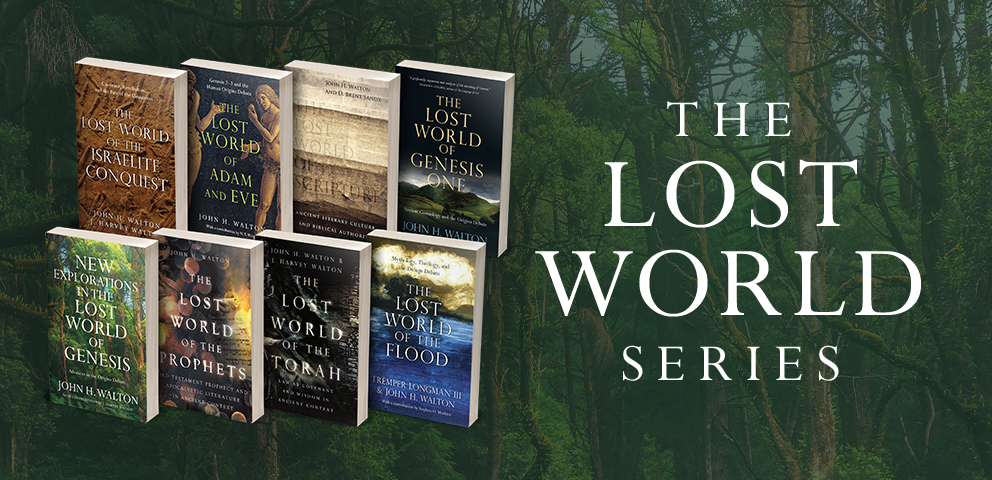
The Lost World Series
Some historical or biblical issues are inherently controversial, which is why they continue to spark debate. The books in the Lost World Series, following the pattern set by Old Testament scholar John H. Walton, offer a fresh perspective by closely examining the Hebrew text and presenting accessible discussions on these complex issues.
Structured through clear propositions, each book guides the reader step-by-step through the key points of the discussion. These insights are grounded in an understanding of ancient Near Eastern literature and cultural context, supported by a careful and consistent hermeneutic. The authors seek to uncover God’s authoritative message as it was understood by the original audience—working out the principle that while the Bible is written for us, it was not written to us.
The Lost World Series does not claim to provide a single “correct” interpretation of Scripture. Instead, it offers interpretations rooted in the conviction that the Bible is truly the Word of God. The goal is not to persuade readers to adopt the authors’ conclusions, but to present the information and insights that have guided the authors in their own journey through these passages. These books invite readers into thoughtful reflection and deeper understanding of some of the most difficult portions of the Bible.
Key Features:
- Accessible Biblical Scholarship: Each book is informed by extensive research into the Hebrew text and ancient Near Eastern literature, presented in a way that is clear and approachable for non-specialists.
- Propositional Structure: Topics are addressed through a series of propositions, guiding readers through a logical and sequential exploration of the issues.
- Straightforward Presentation: Centered on the belief that the Bible is the Word of God, the authors seek to present information in an accessible way without attempting to convert the reader to a specific conclusion.
The Lost World Series is perfect for those who are eager to dig deep, learn intentionally, and grow spiritually while engaging with the complexities of Scripture. Begin your exploration today!
Praise for Books in the Series
"John Walton has been writing insightfully about the book of Genesis for over twenty-five years. His important reminder that the books of the Bible were not written 'to us' but rather 'for us' underscores the importance of reading the books of the Old Testament in their ancient Near Eastern context. John has helped us do just that for years, and in this new book, he revisits the topics that he has treated earlier on the book of Genesis to give us his most recent and best thinking on that foundational book. I recommend New Explorations in the Lost World of Genesis for all readers of the Bible."
—Tremper Longman III, distinguished scholar and professor emeritus of biblical studies at Westmont College
"John Walton's expertise in the Ancient Near Eastern sources enables him to shed a flood of new and unexpected light on the deeper meaning of Genesis 1. The Creator, Genesis is saying, designed heaven and earth as a great temple with the intention of coming to live in it himself--and the sabbath isn't just a nice break after the work is done, but the moment when he takes up residence in the world he has just made. The implications of this resonate right through the rest of the Bible. This is not just a book to invite 'creationists' to think differently; it is a book to help all Bible students read the whole of Scripture with fresh eyes."
—N. T. Wright, Senior Research Fellow at Wycliffe Hall, Oxford University
"We who are committed to the authority of Scripture believe it is inerrant in all that it affirms. Determining what it's affirming is the tricky part, and that is precisely what John Walton helps us discern. Armed with a robust knowledge of the Old Testament and its ancient context, Walton equips Christians to read Genesis on its own terms rather than the terms we've inherited from the modern 'science versus faith' narrative of our culture. As a result Walton opens up new possibilities in the ongoing theological and biblical debate concerning human origins with strong scholarship and Christ-like humility."
—Skye Jethani, author of With: Reimagining the Way You Relate to God
About the Series Author
John H. Walton

John H. Walton is professor emeritus of Old Testament at Wheaton College and Graduate School. His many books include The Lost World of Genesis One and Wisdom for Faithful Reading.
Subtotal: $0.00
-
 Paperback
New Explorations in the Lost World of Genesis
Advances in the Origins Debate
The Lost World Series
by John H. Walton
Contributions by J. Harvey WaltonUpdating and expanding upon his previous work on origins, this riveting volume from John H. Walton marks the eighth entry in his bestselling Lost World Series, which has sold more than 125,000 copies.
For over a decade, JohnWalton's books The Lost World of Genesis One and The Lost World of Adam and Eve have shaped readers' understanding of the ancient Near ...
-
 Audiobook
New Explorations in the Lost World of Genesis
Advances in the Origins Debate
The Lost World Series
by John H. Walton
Contributions by J. Harvey Walton
Read by Jamie RenellUpdating and expanding upon his previous work on origins, this riveting volume from John H. Walton marks the eighth entry in his bestselling Lost World Series, which has sold more than 125,000 copies.
For over a decade, JohnWalton's books The Lost World of Genesis One and The Lost World of Adam and Eve have shaped readers' understanding of the ancient Near ...
-
 Paperback
The Lost World of the Prophets
Old Testament Prophecy and Apocalyptic Literature in Ancient Context
The Lost World Series
by John H. Walton
Are the prophets speaking about their own times, about our present, or about some still-unrealized future? Applying his signature method, John Walton provides a clear, helpful guide to the nature of biblical prophecy and apocalyptic literature that will help us avoid potential misuse and reclaim the message of the prophets for our lives.
-
 Paperback
The Lost World of the Torah
Law as Covenant and Wisdom in Ancient Context
The Lost World Series
by John H. Walton and J. Harvey Walton
To modern eyes, what we call the biblical law, or Torah, seems either odd beyond comprehension (not eating lobster) or positively reprehensible (executing children). Using a consistent methodology to look at the Torah through the lens of the ancient Near East, Walton and Walton offer a restorative understanding that will have dramatic effects in interpreting the text and in discerning the significance of the Torah for today.
-
 Paperback
The Lost World of the Flood
Mythology, Theology, and the Deluge Debate
The Lost World Series
by John H. Walton and Tremper Longman III
Contributions by Stephen O. MoshierThe Genesis flood account has been probed and analyzed for centuries. But what might the biblical author have been saying to his ancient audience? In order to rediscover the biblical flood, we must set aside our own cultural and interpretive assumptions and visit the distant world of the ancient Near East. Walton and Longman lead us on this enlightening journey toward a more responsible reading of a timeless biblical narrative.
-
 Paperback
The Lost World of the Israelite Conquest
Covenant, Retribution, and the Fate of the Canaanites
The Lost World Series
by John H. Walton and J. Harvey Walton
Perhaps no biblical episode is more troubling than the conquest of Canaan. But do the so-called holy war texts of the Old Testament portray a divinely inspired genocide? John Walton and J. Harvey Walton take us on an archaeological dig, reframingour questions and excavating the layers of translation and interpretation that cloud our perception of these difficult texts.
-
 Paperback
The Lost World of Adam and Eve
Genesis 2-3 and the Human Origins Debate
The Lost World Series
by John H. Walton
Contributions by N. T. WrightWhat if reading Genesis 2–3 in its ancient Near Eastern context shows that the creation account makes no claims regarding Adam and Eve's material origins? John Walton's groundbreaking insights into this text create space for a faithful reading ofScripture along with full engagement with science, creating a new way forward in the human origins debate.
-
 Paperback
The Lost World of Scripture
Ancient Literary Culture and Biblical Authority
The Lost World Series
by John H. Walton and Brent Sandy
Walton and Sandy summarize what we know of orality and oral tradition as well as the composition and transmission of texts in the ancient Near East and the Greco-Roman world, and how this shapes our understanding of the Old and New Testaments. Theauthors then translate these insights into a helpful model for understanding the reliability of Scripture.
-
 Paperback
The Lost World of Genesis One
Ancient Cosmology and the Origins Debate
The Lost World Series
by John H. Walton
With an astute mix of cultural critique and biblical scholarship, John H. Walton presents and defends twenty propositions supporting a literary and theological understanding of Genesis 1 within the context of the ancient Near Eastern world and unpacks its implications for our modern scientific understanding of origins.


