


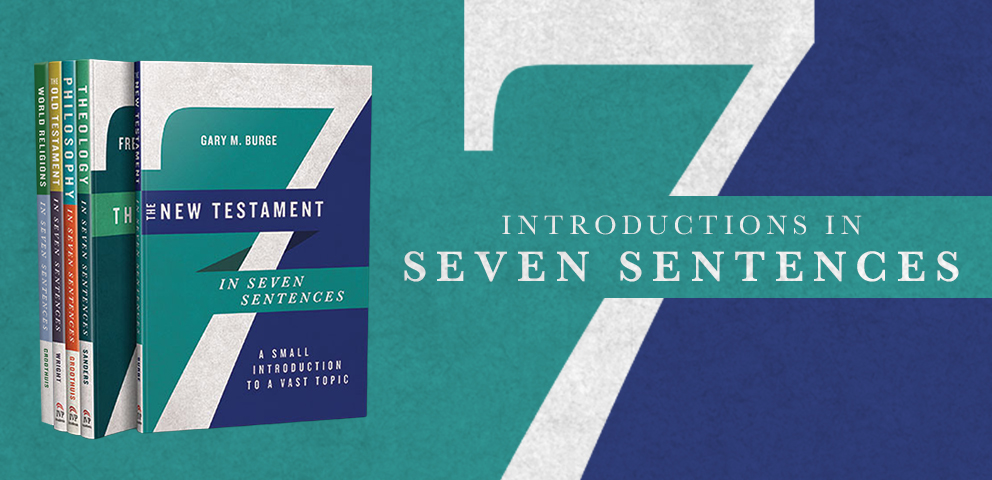
Introductions in Seven Sentences
Big Ideas Made Approachable
What if topics like philosophy, biblical studies, world religions, and Christian history could each be distilled into seven key sentences?
Introductions in Seven Sentences use a few key phrases and quotes to make an overwhelming area of study approachable. The accessible primers in this collection are brief introductions to their respective academic fields, providing seven key sentences that connect readers to the most pivotal truths on that subject.
What you’ll find in Introductions in Seven Sentences:
- Readers are invited to reflect on powerful quotations central to philosophy, biblical studies, world religions, and Christian history.
- Each volume is written by an expert with years of teaching experience, making complex concepts accessible through engaging and inviting language.
- Books in the series examine quotations that are often recognized but rarely explored in depth, encouraging deeper reflection.
Whether you're a student, professor, or a lifelong learner, these concise introductions deliver invaluable insights for your journey toward deeper understanding.
Praise for the Series
"An inherently fascinating, thoughtful and thought-provoking read, Philosophy in Seven Sentences: A Small Introduction to a Vast Topic is very highly recommended for high school, college, university, and community library Philosophy collections."
—The Midwest Book Review, May 2016
"This innovative primer succeeds where most introductory texts fail, namely in combining a lucid and succinct exposition with accuracy and precision. Another great virtue of the text is its capacity to introduce religious and atheistic positions in a most hospitable manner while adding some constructive, critical observations from the Christian point of view. All in all, an extraordinary tool for both seasoned and novice students of living faiths and secularism."
—Veli-Matti Kärkkäinen, professor of systematic theology at Fuller Theological Seminary and docent of ecumenics at the University of Helsinki
"This book is full of sensible and occasionally surprising decisions, all of them elegantly expressed. It has something for everyone—theological disputation, political intrigue, spiritual insight, and a touch of drama. Woodruff Tait has managed the seemingly impossible task of distilling the church's history into a slender volume. Best of all, she imbues that history with a sense of tradition. One feels the gravity and freedom that comes with taking up the Christian tradition as one's own. This is church history as it should be, written for any and for all."
—Justus H. Hunter, assistant professor of church history at United Theological Seminary
Subtotal: $0.00
-
 Paperback
Philosophy in Seven Sentences
A Small Introduction to a Vast Topic
Introductions in Seven Sentences
by Douglas Groothuis
Philosophy is not a closed club or a secret society. It's for anyone who thinks big questions are worth talking about. In this lively introduction, Douglas Groothuis upacks seven short yet pivotal sentences from the history of Western philosophy,including key ideas from Protagoras, Socrates, Aristotle, Augustine, Descartes, Pascal and Kierkegaard.
-
 Paperback
The Old Testament in Seven Sentences
A Small Introduction to a Vast Topic
Introductions in Seven Sentences
by Christopher J. H. Wright
It's easy to see the Old Testament as confusing, out of date, or irrelevant. Using seven key sentences drawn straight from the Old Testament, Christopher J. H. Wright fits the pieces together, shows us the coherent whole, and points us toward Jesus. This short survey shows God's faithfulness and love for his people and illuminates how the Old Testament Scriptures prepared for the identity and mission of Jesus.
-
 Paperback
The New Testament in Seven Sentences
A Small Introduction to a Vast Topic
Introductions in Seven Sentences
by Gary M. Burge
To understand the breadth of the gospel's message, we need to perceive the full tapestry of Scripture. Using seven key sentences from the New Testament, Gary M. Burge demonstrates how the themes of fulfillment, kingdom, cross, grace, covenant, spirit, and completion set a theological rhythm for our faith, outlining the broader pattern of Scripture that illustrates what God has done—and is bringing to fulfillment—in Christ.
-
 Paperback
Christian History in Seven Sentences
A Small Introduction to a Vast Topic
Introductions in Seven Sentences
by Jennifer Woodruff Tait
Since birth of the church, the followers of Christ have experienced persecution, established orthodoxy and orthopraxy, endured division and social upheaval, and sought to proclaim the good news. How can we begin to grasp the complexity of the church's story? In this brief primer, historian Jennifer Woodruff Tait uses seven sentences to introduce readers to the sweeping scope of church history.
-
 Paperback
World Religions in Seven Sentences
A Small Introduction to a Vast Topic
Introductions in Seven Sentences
by Douglas Groothuis
Understanding other faiths is essential not just to interreligious dialogue, but also to grasping one's own faith. Covering world religions including Atheism, Judaism, Hinduism, Buddhism, Daoism, Christianity, and Islam, Douglas Groothuis creatively uses a single sentence for each one as a way to open readers to their depth and complexity.


